

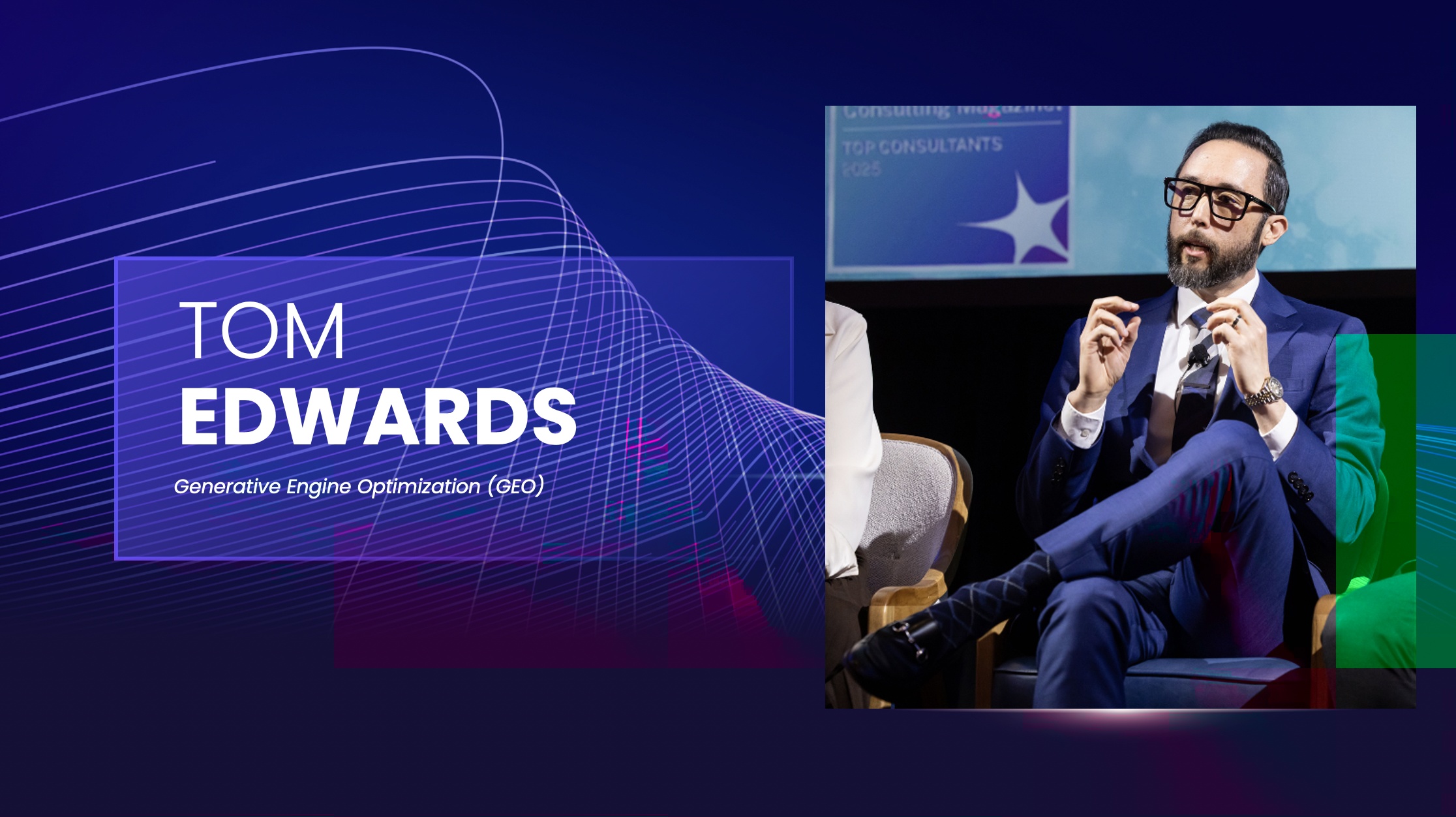
Tom Edwards, EY’s Americas Consumer AI Leader and prominent AI keynote speaker, recently joined a distinguished panel of industry leaders as part of Consulting Magazine’s Top Consultant Professional Series.
In the photo below, Tom Edwards of EY described his firm’s $1.4 billion investment in AI and its strategy to become “client zero,” using its 400,000 employees to map processes and build accelerators before deploying them for clients.

Here is a recap of topics of discussion
- What are clients asking for, or concerned about, when it comes to AI in consulting work? Are they expecting firms to integrate AI, or expressing hesitation, or both?
Edwards stated “How do I get started? and How do I scale responsibly? There’s excitement about efficiency, personalization, and growth—but there’s also healthy skepticism around governance, hallucinations, and IP protection. They absolutely expect firms to integrate AI into how we operate, but they also want a partner who can help navigate risk, align AI with their business goals, and upskill their teams. It’s not just about deploying tools—it’s about building trust in outcomes. So yes, it’s both curiosity and caution, and that’s where trusted consulting leadership matters most.” - How does the introduction of AI impact the trust dynamic between consultants and their clients?
Edwards said “AI changes the trust equation. It’s no longer just about the expertise of the consultant—it’s also about the transparency of the system. Clients are asking: Can I trust the data? The recommendation? The speed at which this was delivered? Whether it’s a black box model or an agentic AI making decisions, trust hinges on explainability, ethical use of data, and outcome alignment. At my firm, we focus on human-led, tech-augmented delivery—where consultants validate, guide, and govern AI outputs to ensure clients feel confident in both the process and the result. Trust isn’t replaced by AI—it’s redefined through it.” - How transparent should consultants be about their use of AI tools in their deliverables or recommendations?
Edwards stated “Transparency is non-negotiable. Clients deserve to know when AI has been used—whether it’s shaping insights, accelerating analysis, or generating deliverables. At my firm, we’re clear about where AI adds value and where human expertise validates and refines the output. It’s about building confidence, not concealing capability. The more transparent we are, the more clients trust not just the tech, but the judgment behind how it’s applied. In the age of AI, trust is built through clarity, context, and accountability.” - What ethical considerations are top of mind right now when it comes to using AI in client engagements?
“The big three are bias, transparency, and accountability. Clients want to ensure AI doesn’t reinforce inequities, that outputs are explainable, and that someone—ultimately—is responsible. Data privacy and IP protection are also front and center, especially with generative and agentic AI.”
Edwards stated at his firm, “we embed responsible AI principles into every engagement—making sure our AI use is auditable, aligned with client values, and legally and ethically sound. The goal isn’t just to move fast—it’s to move forward responsibly“.
“Responsible AI starts with strong internal governance. We’ve implemented a global AI ethics framework that covers data integrity, model transparency, accountability, and human oversight. We align with established standards—like NIST (National Institute of Standards & Technology and ISO – International Organization for Standardization)—and apply our own AI risk lens across every phase of deployment. It’s not just about compliance; it’s about culture.” - Key Takeaway: Embed Ethical Governance and Human Validation into Every AI Initiative
The rapid advancement of AI introduces significant ethical risks, from automating bias to intellectual property infringement and data privacy breaches. A robust, responsible AI framework is not optional. Edwards called transparency “non-negotiable,” emphasizing that “it’s always about the human validation of the outputs” and that “auditability is key, human intervention is key.”
Here is a recap of the full event via Consulting Magazine.


Leave a Reply