
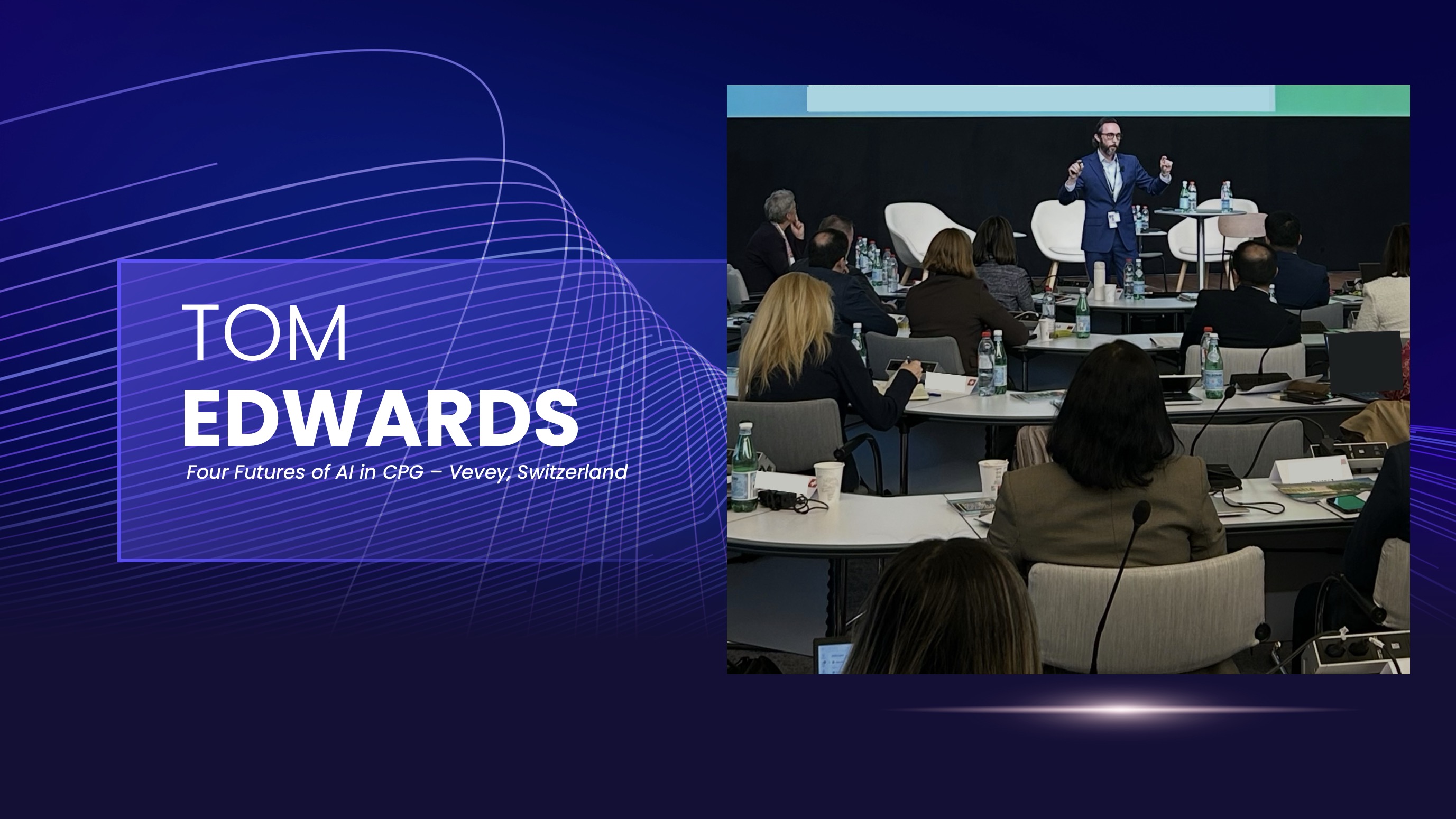
Last week, I had the opportunity to spend time in Vevey, Switzerland speaking with global Consumer Product leaders about one of the most important shifts to consider over the next 18 months: the transition from AI as a tool to AI as an operating environment.
Multiple sessions focused on the EY Four Futures of AI specific to CPG. We explored what the Growth and Transform Futures mean for the future of consumer products, enterprise operations, and human behavior.
The conversation is no longer centered on whether AI will impact the industry. The real question is: How quickly can organizations redesign themselves for a world where intelligence becomes ambient, contextual, and increasingly autonomous?
The Growth Future: AI Improves the System
In the Growth Future, AI acts as an amplifier. Organizations use AI to optimize workflows, improve decision-making, accelerate research, automate repetitive tasks, and increase operational efficiency across the value chain.
We discussed how leading organizations are already moving aggressively in this direction through initiatives such as:
- AI-assisted demand forecasting and supply chain optimization
- Intelligent merchandising and pricing strategies
- AI-enabled consumer insights and trend detection
- Automated content generation and localization
- Knowledge retrieval and enterprise search
- Workforce productivity enablement through copilots and agents
- Decision-support systems embedded into daily workflows
This future is about making existing systems faster, smarter, and more adaptive. Importantly, many organizations are already realizing measurable value here. The Growth Future is tangible, operational, and increasingly becoming table stakes. But the Transform Future is where the conversation becomes significantly more disruptive.
The Transform Future: AI Becomes the System
In the Transform Future, AI is no longer simply improving workflows. It becomes the interface through which consumers, employees, and enterprises interact with the world around them. The environment begins adapting to us rather than us adapting to the environment.
This shift fundamentally changes how we think about:
- Discovery
- Commerce
- Brand engagement
- Enterprise software
- Decision-making
- Customer relationships
- Work itself
We discussed how consumer behavior is already signaling the early foundations of this future. Consumers are increasingly moving from: Searching → Asking → Autonomous Action. That progression matters.
As AI agents become more capable, trusted, and context-aware, consumers will increasingly delegate decisions and actions to intelligent systems acting on their behalf. This creates a major strategic implication for brands.
The future competitive advantage may no longer come solely from owning the product. It may come from owning the context.
From Product-Centricity to Context-Centricity
One of the recurring themes I reiterated throughout the sessions was the shift from product-centricity to context-centricity.
Historically, brands optimized around products, channels, and transactions. In an agentic future, organizations will increasingly need to optimize around context, intent, and interoperability.
The organizations best positioned for the future will build integrated ecosystems of products and services that consumer AI agents can easily navigate, trust, and act upon.
That means:
- Structured, AI-ready data
- Interoperable systems
- Explainability and trust mechanisms
- Context-aware experiences
- Intelligent orchestration layers
- Real-time personalization at scale
The winners in this next era may not simply be the organizations with the best products. They may be the organizations with the most navigable ecosystems.
Preparing for the Agentic Enterprise
During the final executive session, we discussed the “no-regret moves” organizations are taking today to prepare for the agentic enterprise.
Several themes consistently emerged:
Build a Unified Interaction Layer
Organizations are increasingly moving toward a unified interaction model where employees interact with intelligence through copilots, agents, and conversational interfaces rather than fragmented applications.
Reimagine Processes for Both Humans and Agents
Many current enterprise workflows were designed exclusively for humans. Future-ready organizations are redesigning workflows assuming humans and AI agents will operate collaboratively.
Invest Aggressively in Workforce Upskilling
Technology transformation without workforce transformation rarely succeeds. Organizations must help employees understand not only how to use AI, but how to work alongside autonomous systems.
Build Trust, Governance, and Auditability Into the Foundation
As agentic systems make increasingly autonomous decisions, explainability, provenance, governance, and auditability become foundational capabilities, not optional features.
This is where ontologies, semantic frameworks, and structured enterprise knowledge become critically important.
Build an AI-Native Foundation
The future will require scalable AI-native architectures that support orchestration, memory, reasoning, context management, and continuous learning across systems.
Importantly, systems of record still matter deeply in this future. But their role evolves. Systems of record increasingly become systems of truth feeding intelligent orchestration layers that sit above them.
AI Literacy Must Become Experiential
In addition to the Four Futures sessions, I also led an AI Masterclass focused on practical adoption of Microsoft Copilot.
The session focused heavily on hands-on interaction:
- Customizing Copilot
- Using research and analyst agents
- Building custom agents
- Understanding practical workflow integration
- Experimenting directly with AI-assisted productivity
One of the biggest observations from these sessions is that AI literacy accelerates dramatically through interaction, not observation. People learn AI best by getting hands-on with the tools. The organizations moving fastest are creating environments where experimentation is encouraged, accessible, and embedded into everyday work.
Final Thought
We are entering a period where AI is shifting from an application layer to an environmental layer. That distinction matters. The future is not simply about adding AI into existing systems. It is about redesigning enterprises, experiences, and ecosystems around intelligence itself.
For Consumer Products organizations, this shift will redefine how brands engage consumers, how decisions are made, how work gets done, and ultimately how value is created.
The organizations that succeed will not simply deploy more AI. They will rethink how the enterprise operates in a world where intelligence is always present, increasingly autonomous, and deeply contextual.
Leave a Reply