
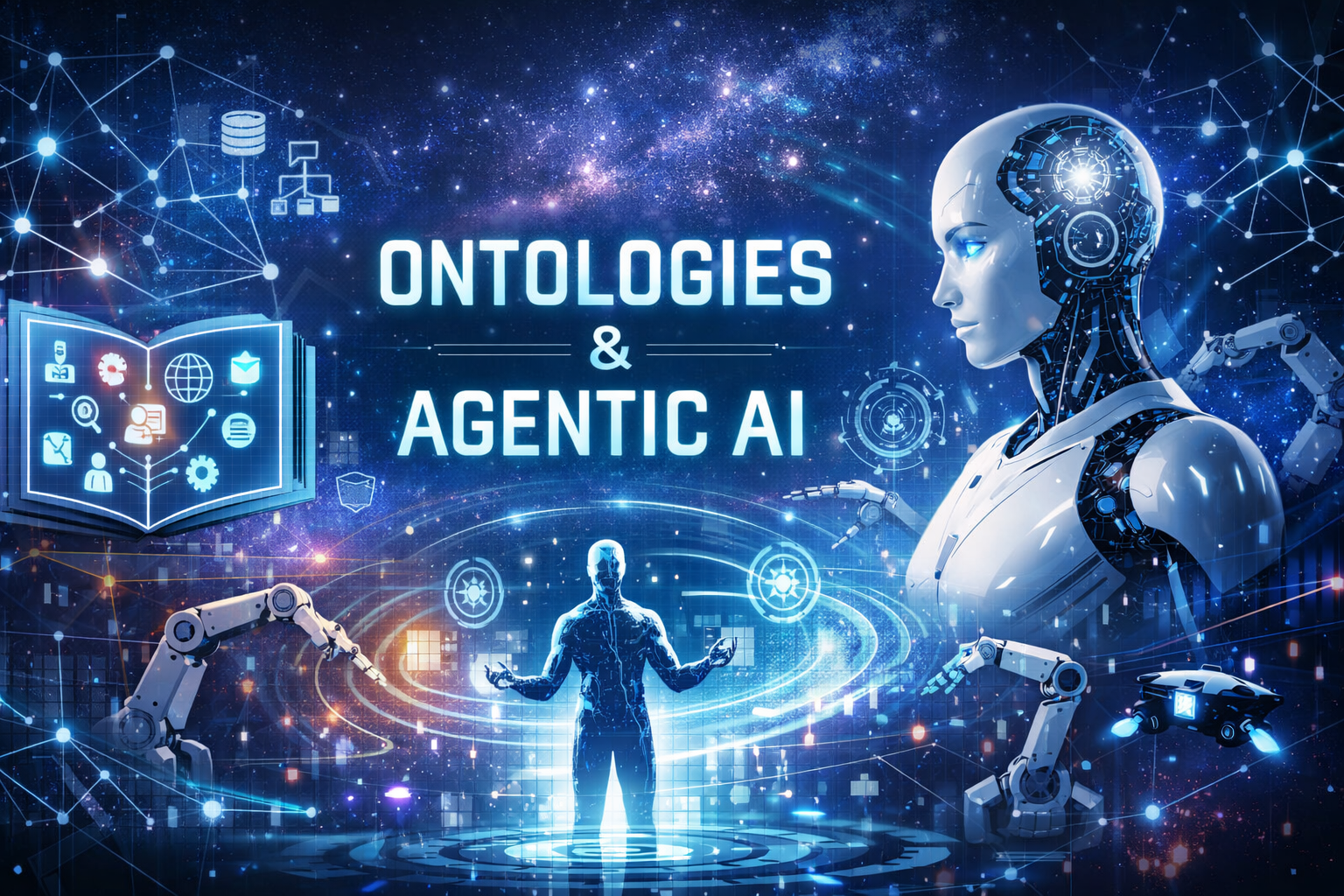
Scaling agents across domains—without scaling chaos. Agentic AI is finally moving from “copilot” to “operator”: systems that can plan, call tools, execute workflows, and coordinate across teams. But there’s a hard truth most enterprises are about to re-learn the painful way:
Agents don’t fail because the model is dumb. Agents fail because the enterprise is semantically inconsistent. Agentic AI is 80% knowledge engineering!
When “Customer,” “Order,” “Shipment,” “Obligation,” “Incident,” or even “Campaign” mean different things across functions—and change depending on the system you ask—your agents are forced to guess. That’s where hallucinations, unsafe tool calls, broken automations, and audit nightmares come from.
This is why ontologies matter.
Ontologies are formal, machine-interpretable models of a domain’s concepts and relations—commonly implemented using Semantic Web standards like RDF (triples), OWL (semantics + inference), and SHACL (validation).
In the agentic enterprise, ontologies become the semantic contract between:
- enterprise data + events
- knowledge graphs (and GraphRAG-style retrieval pipelines)
- agents that must ground language into safe, auditable action
Design Pattern: Hub-and-Spoke Ontologies
A single monolithic “enterprise ontology” rarely scales—politically, operationally, or technically. With that in mind, here is an interactive experience I created that demonstrates some of the core concepts and considerations for ontologies and the agentic enterprise.
Ontologies are not “data modeling.” They are the operating system for the agentic enterprise.
- a stable enterprise semantic API (hub)
- domain autonomy via spokes
- explicit crosswalks that let agents traverse workflows
- provenance + policy as first-class graph objects
- validation and regression testing as CI gates
- a hybrid graph stack tuned for both semantics and operations
That’s how you scale agentic AI across marketing, finance, supply chain, HR, legal, and IT—without scaling risk.
Leave a Reply