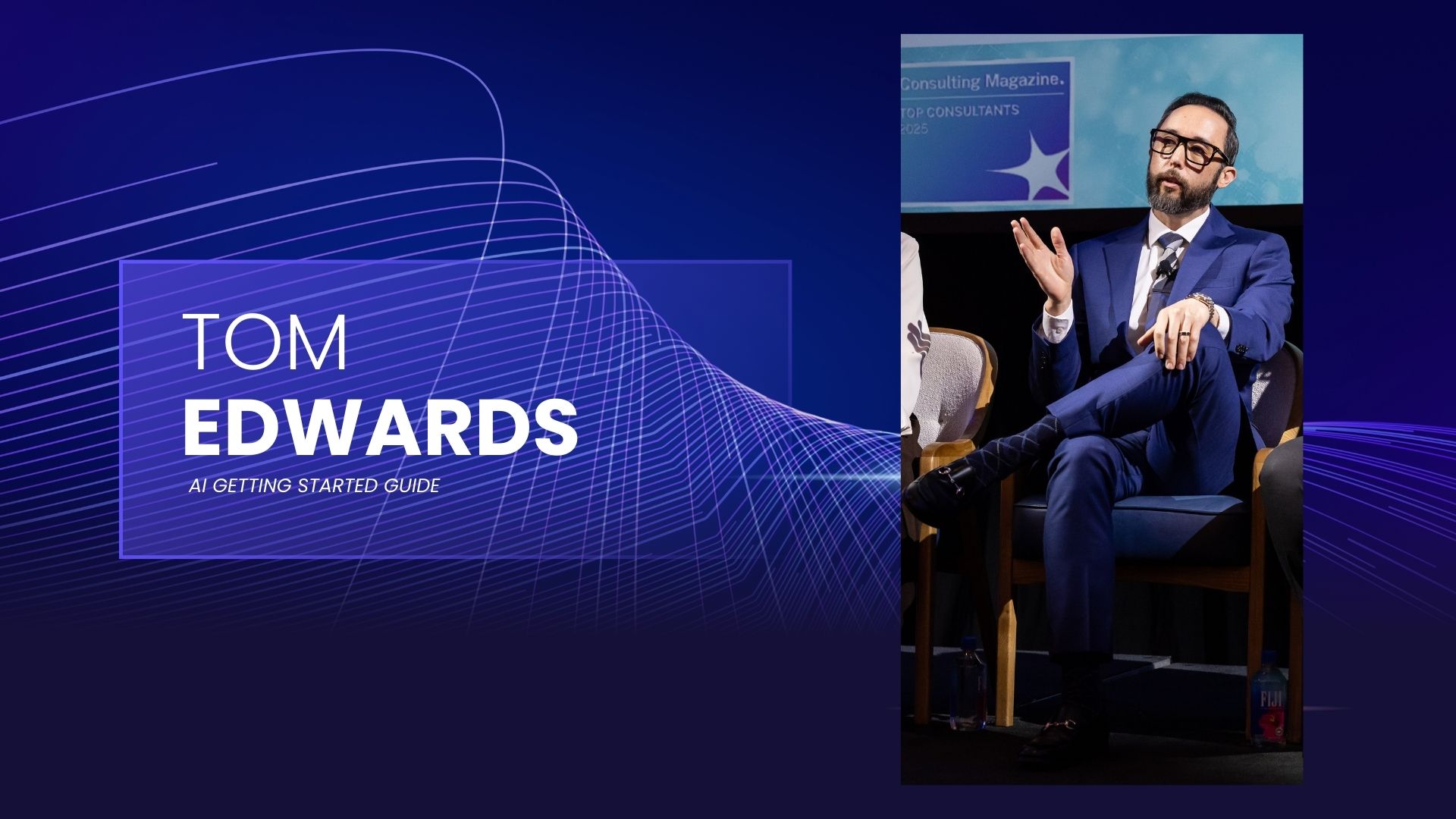
8 Steps to Get Started with AI, Generative AI & Agentic AI: A Practical Guide for Beginners
By Tom Edwards, AI Keynote Speaker
If you’ve been curious about artificial intelligence—maybe you’ve experimented with ChatGPT, or perhaps you’re just beginning to hear terms like “generative AI” or “agentic AI”—this guide is for you. Whether you’re an entry-level worker, business owner, strategist, technologist, or executive, understanding how to leverage these technologies is quickly becoming a must-have skill.
I’ve spent the last decade helping organizations navigate AI. Today, I’ll break down the core concepts to give you a practical path forward, and share the best ways to start creating value with AI right now.
🚀 Step 1: Understanding the Landscape
1. Artificial Intelligence (AI):
AI refers to machines that mimic human intelligence. Think of it as the broader category. It powers everything from your smartphone assistant to your Netflix recommendations.
2. Generative AI:
This is a subtype of AI that creates content—text, images, video, code. Tools like ChatGPT, DALL·E, and Midjourney fall under this. It’s the engine behind the creative explosion we’re seeing today.
3. Agentic AI:
This is where it gets really exciting. Agentic AI combines decision-making with autonomy. Think of it as a digital co-pilot that not only generates insights but can take actions, coordinate tasks across platforms, and collaborate with humans in real time. It’s the foundation of AI transformation at scale.
Want a deeper dive? Check out the BlackFin360 Evolution of Experience framework which shows how we move from Empowered (individual AI use) to Exponential (AI-infused organizations) to Enhanced (AI-human symbiosis).
👉 Explore the Framework
🛠️ Step 2: Best Tools & Platforms to Get Started
For Text & Ideation:
- ChatGPT (Free/Pro) – For drafting, ideation, summarization.
- Claude – Great for large context documents and summarizing PDFs.
- Perplexity – A smart AI search assistant for fast research.
For Visuals:
- DALL·E (inside ChatGPT) – Generates images from text prompts.
- Midjourney – Beautiful imagery through Discord-based interaction.
- Canva AI – Ideal for presentations and branded content.
For Beginners in Automation / Agentic AI:
- Zapier AI or Make.com – For simple workflows and agent simulation.
- OpenAI GPTs / Assistants API – Build your own AI assistants.
- Microsoft Copilot / Google Gemini – AI baked into productivity tools.
✍️ Step 3: Prompting Best Practices
AI is only as good as your input. Mastering prompt crafting is essential. Here are a few tips:
✅ Be clear and specific.
Bad: “Write a summary.”
Better: “Write a 3-sentence summary of this article in a professional tone, focusing on the business impact.”
✅ Use roles and context.
Example: “Act as a CPG brand strategist. Suggest three campaign concepts for a new protein bar targeting Gen Z.”
✅ Provide structure.
Use bullet points, tables, or ask for a specific format: “Write a pros and cons list,” or “Generate a 5-day content plan.”
✅ Iterate.
Great AI users refine, reprompt, and fine-tune. Think of the AI as a collaborator, not a vending machine.
More on prompt engineering here →
👉 Tom Edwards AI Prompt Guide
📈 Step 4: Start Small, Scale Fast
You don’t need to boil the ocean. Start with high-impact, low-risk use cases:
- Marketing & Sales: Generate ideas, scripts, emails, or client research.
- Internal Ops: Summarize meetings, draft documentation, automate responses.
- Customer Experience: Train AI agents to support FAQs or triage feedback.
Then evolve toward agentic AI by connecting systems and letting AI act as a workforce multiplier—augmenting human effort, reducing manual work, and driving real business impact.
🧭 Step 5: Key Considerations for Business Owners
As a business leader, the adoption of AI isn’t just about experimentation—it’s about strategy, scale, and sustainable value. Here are five key considerations to keep top of mind:
1. Define the “Why” Behind AI Adoption
Start by identifying the business outcome, not the technology. Are you aiming to reduce operational costs, improve customer experience, or accelerate content velocity? Clear objectives will guide platform choices, data strategies, and use case prioritization.
📌 Tip: Align AI initiatives to growth drivers like revenue generation, margin expansion, or increased speed-to-market.
2. Prioritize Data Readiness
Generative and Agentic AI thrive on quality data. Ensure your internal data is clean, structured, and accessible. You don’t need perfect data to start—but you do need a plan.
📌 Tip: Invest in data tagging, metadata enrichment, and governance to make your knowledge assets AI-ready.
3. Start with High-Impact, Low-Risk Use Cases
Focus on departments where AI can quickly add value:
- Sales scripts and lead qualification
- Marketing content generation
- Customer service automation
- Internal documentation or knowledge retrieval
📌 Tip: These are ideal pilots before expanding into complex, multi-agent or autonomous workflows.
4. Build AI Fluency Across Teams
AI is not just an IT initiative. Upskilling is key. Encourage experimentation with tools like ChatGPT or Microsoft Copilot across all departments. Establish an internal AI council to coordinate strategy and compliance.
📌 Tip: Think of AI literacy as the new digital literacy—critical for every role, not just data teams.
5. Balance Innovation with Responsible AI
Transparency, trust, and risk mitigation are vital. Ensure you’re adhering to ethical AI frameworks (like NIST or ISO), and create internal policies around AI usage, especially for customer-facing interactions.
📌 Tip: Adopt a “human-in-the-loop” approach for critical decisions. Agentic AI should support—not replace—judgment where it matters most.
Adding this step ensures the post resonates not just with beginners and enthusiasts, but also with decision-makers seeking to translate interest into impact.
🛡️ Step 6: Governance & Responsible AI Considerations
As AI capabilities scale, so do the risks. From data privacy to hallucinations to bias, responsible AI isn’t optional—it’s essential. Businesses must proactively manage how AI is governed, monitored, and aligned to core values.
Here are key governance considerations:
1. Establish a Responsible AI Framework
Adopt recognized standards like:
- NIST AI Risk Management Framework – Helps assess and mitigate risks across AI lifecycle stages.
- ISO/IEC 42001 – The first certifiable global AI management system standard, guiding AI controls and accountability.
📌 Tip: Use these frameworks as a foundation for internal policies and audits.
2. Design for Transparency & Explainability
Ensure stakeholders understand how AI makes decisions—especially in customer-facing or regulated use cases.
📌 Tip: Prioritize explainable models, document prompt chains for GenAI outputs, and clearly flag AI-generated content.
3. Implement Guardrails for Data & Model Usage
Define clear policies for:
- What data can be used for training/fine-tuning
- How customer data is protected
- Which AI tools are approved for employee use
📌 Tip: Leverage permission layers, data masking, and internal AI usage registries.
4. Monitor for Drift, Bias & Hallucination
Continuously test models and outputs. Even well-trained AI can produce unexpected or biased results over time.
📌 Tip: Set up feedback loops, confidence thresholds, and use human review for sensitive outputs.
5. Ensure Human Oversight in Agentic Systems
Agentic AI introduces autonomy. Safeguards are needed to manage unintended actions, especially in high-stakes environments.
📌 Tip: Adopt a “human-on-the-loop” model—where agents can act but escalate exceptions, and key decisions remain reviewable.
By embedding governance early, you not only reduce risk—you build trust. Trust is the currency of transformation, and responsible AI is the foundation.
Together, these six steps provide a comprehensive starting point for individuals and businesses alike to move from experimentation to enterprise-grade AI capability.
📚 Step 7: Training & Upskilling Your Workforce
AI success isn’t just about tools—it’s about people. For organizations to scale AI impact, they must empower employees with the skills, mindset, and confidence to collaborate with intelligent systems. This is about augmenting human potential, not replacing it.
Here’s how to build an AI-fluent workforce:
1. Start with Awareness & Literacy
Introduce core AI concepts: What is AI? What is GenAI? What are its limitations? Make this foundational knowledge accessible across roles—from the C-suite to the frontline.
📌 Tip: Host AI 101 sessions, leverage free platforms like OpenAI Learn or LinkedIn Learning, and curate role-based learning paths.
2. Promote Hands-On Experimentation
Encourage employees to explore tools like ChatGPT, Microsoft Copilot, or Google Gemini in their daily workflows. Make AI a part of “how we work.”
📌 Tip: Create internal AI sandboxes or prompt libraries where teams can share, learn, and improve together.
3. Design Role-Specific AI Training
Each function will use AI differently. Sales might focus on prospecting and scripting. Finance might use it for scenario modeling. Tailor training to match job outcomes.
📌 Tip: Integrate real use cases into learning modules. Reward efficiency gains and creative uses.
4. Create an Internal AI Champions Program
Identify early adopters and empower them as AI advocates. These champions can lead peer learning, test new tools, and help drive cultural adoption.
📌 Tip: Include champions in your AI governance council to bridge business needs and tech guardrails.
5. Measure Progress & Celebrate Wins
Track AI adoption through metrics like productivity gains, prompt usage, or time saved. Share success stories to build momentum.
📌 Tip: Include AI skill development in performance reviews and create incentives for innovation.
Empowering your people is the most sustainable competitive advantage in the AI era. The organizations that win won’t be the ones with the most tech—they’ll be the ones with the most AI-empowered teams.
📊 Step 8: Measuring the Value of AI
AI isn’t a novelty—it’s a business accelerator. But to earn stakeholder trust and secure future investment, you must measure its impact. That means going beyond “cool use cases” to track tangible outcomes across productivity, profitability, and performance.
Here’s how to establish a value-driven AI measurement framework:
1. Align AI Initiatives to Business KPIs
Every AI project should ladder up to a core strategic priority:
- 🔁 Efficiency (e.g. time savings, automation rates)
- 💰 Revenue (e.g. conversion uplift, lead velocity)
- 💡 Innovation (e.g. idea velocity, content generation scale)
- ❤️ Experience (e.g. NPS, reduced response times)
📌 Tip: Tie AI metrics directly to financial or operational goals. Speak the language of the CFO.
2. Define Metrics Across the Lifecycle
Track AI value across three horizons:
| Stage | Metrics Examples |
|---|---|
| Pilot/Prototype | Time saved, task completion rate, adoption |
| Scaled Deployment | Cost per output, agent ROI, model accuracy |
| Enterprise Impact | Revenue uplift, margin expansion, workforce gain |
📌 Tip: Use control groups or baselines to show lift from AI adoption.
3. Include Human Impact Metrics
Agentic and GenAI tools are workforce multipliers. Track how they affect:
- 💼 Employee satisfaction and enablement
- ⏱️ Time reallocated to high-value work
- 📈 Talent productivity (outputs/hour or per role)
📌 Tip: Use employee pulse surveys to monitor sentiment around AI usage.
4. Incorporate Risk & Trust Indicators
Value isn’t only upside—it’s also reduced downside. Include:
- ✅ Governance compliance rate
- 🛡️ Hallucination/error detection rate
- 🔄 Feedback loop participation
📌 Tip: Value = benefit minus risk. Factor responsible AI into your ROI models.
5. Build an AI Value Dashboard
Centralize performance tracking in real-time:
- Integrate data from workflow tools, CRM, and AI agents
- Visualize by function, agent, or business unit
- Include narrative context for executive clarity
📌 Tip: Use AI to analyze AI—let agents surface insights from their own performance data.
When AI is measured like a business unit—not a tech experiment—it earns its place as a core driver of growth, efficiency, and innovation.
📚 Additional Resources from BlackFin360
- 🎤 Tom Edwards AI Keynote Summary: Empower, Exponential, Enhanced
- 🔎 Agentic AI Explained
- 🧠 The Evolution of AI
💡 Final Thought
This is more than a tech trend—it’s a shift in how we create, decide, and deliver. If you’re just starting out, stay curious, practice often, and view AI as a powerful ally in your day-to-day work.
As I often say: The future isn’t human vs. machine—it’s human + machine.
Let’s evolve the experience—together.

—
Tom Edwards
AI Keynote Speaker
🔗 Connect on LinkedIn | 🌐 BlackFin360.com